Here in Collin County, we don't ease into summer — it shows up fast and it runs hard. By the time June rolls in, your coolant, brakes, tires, and battery are already fighting triple-digit heat with no warm-up. May is your window. If you've been putting off a vehicle inspection, this is the month to handle it — before the heat turns a small problem into a roadside breakdown.
Cooling System — Your Engine's First Line of Defense
The cooling system takes more abuse in a Texas summer than any other season. Coolant degrades over time and loses its ability to regulate temperature — and a degraded coolant in 105°F heat is a recipe for overheating. Check the reservoir level, the color of the fluid, and the condition of your hoses. Old coolant runs brown or rust-colored. Hoses should feel firm, not spongy or cracked at the ends where they connect to fittings.
If your coolant hasn't been flushed in the last two years or 30,000 miles, now's the time. It's one of the easier jobs to DIY with the right workspace.
Never open a hot radiator cap. Let the engine cool completely — 30+ minutes — before checking coolant. Even a mildly pressurized system can spray scalding fluid.
Battery — Heat Kills Batteries Faster Than Cold
Most people think of cold weather as the battery killer. In reality, it's the summer heat that accelerates internal battery degradation — and then the cold snap in November is when it finally gives out. By the time your battery fails in the fall, summer already did the damage.
If your battery is 3+ years old, test it now. A load test takes under 10 minutes and most auto parts stores will do it free. If you're testing it yourself, a healthy battery under load should hold above 9.6V. Anything below that and you're rolling the dice.
While you're at it, clean the terminals. Corrosion — the white or blue-green buildup on the posts — kills connection and makes your charging system work harder than it needs to.
Brakes — Hot Pavement, Heavy Traffic, No Shortcuts
Summer means more road trips, more highway miles, and more heat cycling on your brake components. If you've been noticing any squeal, grinding, or a pedal that feels softer than usual, don't wait until fall to address it. Brake pads should ideally have at least 3–4mm of material left heading into a high-use season. Rotors should be smooth, not scored with deep grooves.
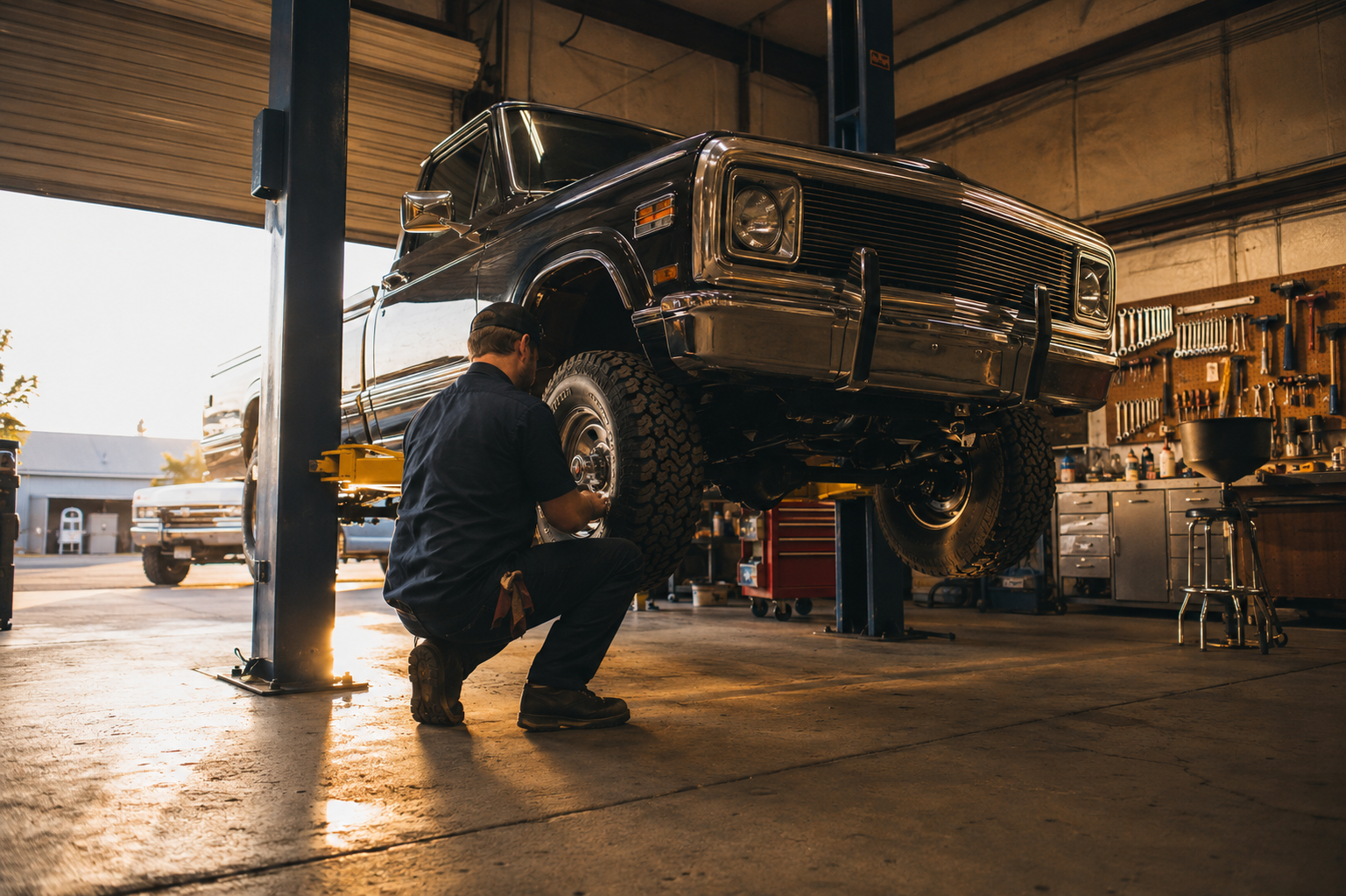
This is one of the most satisfying DIY jobs — straightforward enough for a first-timer with the right lift and tools, and the savings are significant compared to having a shop do it. Brake jobs on a 2-post lift in a climate-controlled bay beat laying under a car in a parking lot every single time.
Our 10,000 lb lift bays are set up for exactly this kind of work. Rent by the hour or grab a 6-hour package if you're doing pads and rotors on all four corners — you'll want the time.
Tires — Pressure, Tread, and What the Pavement Is Actually Telling You
Tire pressure rises approximately 1 PSI for every 10°F increase in ambient temperature. That means if your tires were properly inflated in March at 65°F, they may be running over-inflated by late June. Over-inflation reduces the contact patch, affects handling, and accelerates wear in the center of the tread.
Check your tire pressure when the vehicle has been parked for at least 3 hours — hot tires give you false readings. Set to the spec on the door placard, not the number stamped on the tire sidewall (that's the max, not the spec). While you're in there, check your tread depth with a quarter: if Lincoln's head is fully visible, you're under 4/32" — start shopping.
Uneven wear is your alignment and suspension sending you a message. Center wear = over-inflation. Edge wear = under-inflation. One-sided wear = alignment is off. Cupping or scalloping = shocks or struts are worn. The tire doesn't lie.
A/C System — Find Out Now, Not on I-75 in July
If your A/C has been a little weak this spring, it won't get better when temperatures hit triple digits. The most common culprit is low refrigerant — either from a slow leak or normal system losses over time. A basic A/C check involves testing system pressure, checking the compressor engagement, and inspecting the condenser (the front-facing coil near your radiator) for debris or damage.
Handling refrigerant requires an EPA 609 certification, so recharging the system is a job for a licensed tech. But diagnosing what's going on, checking for visible leaks, and cleaning the condenser fins? That's DIY territory. If you need a full A/C service, we can handle that on the mechanical side.
Park facing away from direct sun when possible, and crack your windows slightly when parked to reduce the interior heat load your A/C has to overcome on startup. It's a small thing that adds up.
Handle It Yourself — We've Got the Space
Rent one of our 5 lift bays starting at $50/hour, or grab a flat bay for ground-level work starting at $30/hour. Professional tools included. Climate-controlled. Staff on site. Located just off US-75 in Anna, TX — easy access from McKinney, Melissa, Celina, and Prosper.
Book a Bay →The Bottom Line
None of this is complicated. It's just attention to detail applied early, before summer forces your hand. An hour in May is worth five hours on the side of the road in August. Walk around your vehicle this weekend, get under it if you have the space, and go through this list. If you don't have the space — we do.
OGC10 Garage is a veteran-owned DIY bay rental shop in Anna, TX. We exist to give drivers and enthusiasts the right environment to work on their own vehicles — without pressure, without judgment, and with everything you need to do the job right.