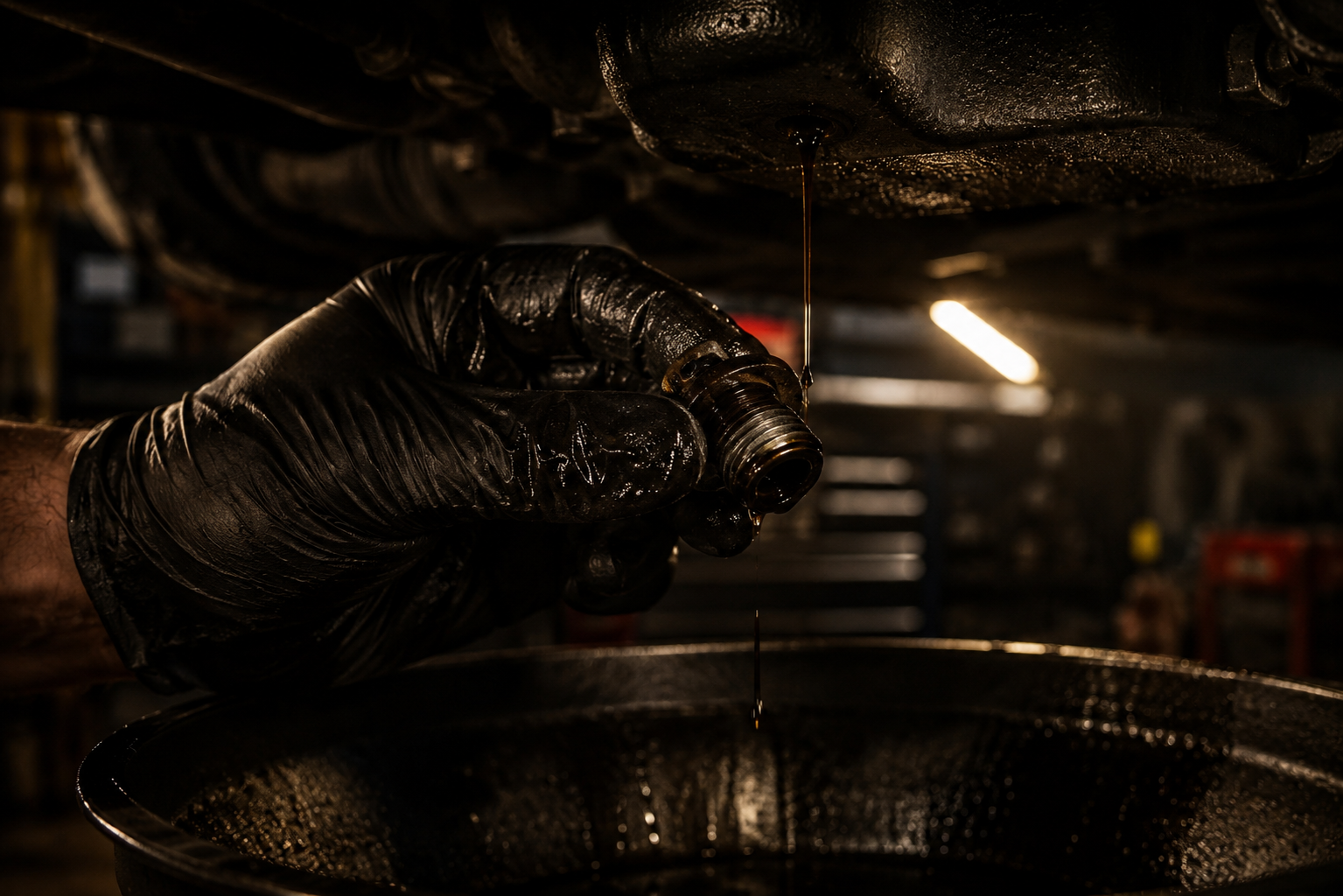
Let's be honest. The oil change industry has done a number on people. Between the 3,000-mile sticker on your windshield, the upsell checklist at every quick-lube counter, and about a thousand conflicting opinions on synthetic vs. conventional — most drivers don't actually know what their engine needs. They just know they're supposed to do something, and they do it, and they pay for it.
Here's what's actually true in 2026.
The 3,000-Mile Rule Is Dead. It Has Been for Years.
If your vehicle was built after 2010, you almost certainly do not need an oil change every 3,000 miles. Most modern engines — domestic and import — are engineered for 5,000 to 7,500 miles between changes on conventional oil. Many full-synthetic applications are rated for 10,000 miles or more.
The 3,000-mile recommendation was accurate — for engines built in the 1970s and 80s. Looser tolerances, older metallurgy, less refined oil. That was then. Today's engines are a different animal entirely.
The sticker stays on your windshield because it's good for business. Not because it's good for your engine.
The actual rule
Check your owner's manual. Specifically, look for the OEM-recommended interval under normal driving conditions. That number is what your engine was designed around. Use it.
Synthetic vs. Conventional: What Actually Matters
Full synthetic oil is a better product. That's not debatable. It handles temperature extremes better, flows more easily on cold starts, and maintains viscosity longer. For most people driving in North Texas heat — especially those doing highway miles on US-75 — synthetic makes sense.
But here's what the quick-lube counter won't tell you: if your vehicle specifies conventional oil and you're not pushing the engine hard, conventional changed at the right interval is completely fine. The upgrade to synthetic doesn't fix a neglect problem. Changing your oil at 12,000 miles on synthetic is worse than changing it at 5,000 miles on conventional.
A few situations where synthetic is worth it regardless of what the manual says:
- High-performance or turbocharged engines
- Trucks and SUVs doing regular towing or hauling
- Vehicles sitting for extended periods (synthetic resists breakdown better)
- Older high-mileage engines that run hot
One exception: if your engine has older seals, switching from conventional to full synthetic can cause leaks. High-mileage synthetic formulas exist specifically for this reason. If you're not sure, ask before you switch.
What the Quick-Lube Upsell Is Actually About
Here's how it works. You pull in for a $29.99 oil change. Fifteen minutes later someone knocks on your window with a printed sheet: cabin air filter, engine air filter, fuel system flush, power steering fluid exchange, differential service. The total climbs to $180 before you've said yes to anything.
Some of that list might be legitimate. Filters do need replacing. Fluids do get dirty. But the timing is almost never based on what your vehicle actually needs right now — it's based on what's on the menu today and what they can show you in the bay.
How to protect yourself:
- Ask when it was last done. If they can't tell you without looking at a sticker, that's your answer.
- Check your maintenance schedule. Most of these services have specific mileage intervals in your owner's manual. Use those, not the service counter's timeline.
- Ask to see the old filter. A good shop will show you. If it's legitimately dirty, the service is legitimate.
- Don't get pressured under the car. You should never feel like you have to decide on the spot. A good mechanic will explain what they found and let you make the call on your own terms.
The Two Factors That Actually Kill Engines
In nearly every case of premature engine wear, the cause comes down to one of two things:
01 — Running low on oil
Not changing oil often enough is a problem. But running an engine low between changes is worse. Check your level every few fill-ups. Two minutes, dipstick, done.
02 — Ignoring warning signs
A ticking noise on cold starts, a persistent oil smell inside the cab, or an oil pressure light are not things to "keep an eye on." Those are calls to action. Catch them early.
The right oil, changed at the right interval, with the level checked occasionally — that's genuinely all it takes. Everything else is noise.
Do It Yourself or Bring It In — Either Way, We've Got You
An oil change is one of the most satisfying first jobs for anyone who wants to start turning their own wrenches. Drain plug, filter, refill, check. You're in and out in 30 minutes with a ground-level flat bay and the right tools. If you've been thinking about doing your own maintenance, this is the best place to start — our flat bay rentals run $30/hr and everything you need is right here, just off US-75 in Anna.
If you'd rather hand it off, our full-service team handles oil changes seven days a week, 9AM–6PM. Straight diagnosis, no pressure, no mystery sheet on your window. We tell you what we found, you tell us what you want done.
Either way — book online or call us at 903-213-5690.
Quick reference — what to actually do
- Look up your OEM oil change interval — it's in the owner's manual
- Match the viscosity spec (5W-30, 0W-20, etc.) — don't guess
- Check your oil level every 2–3 fill-ups
- Note the date and mileage when you change it
- Don't let anyone talk you into services your manual doesn't call for yet